Your go-to library for insights on the payments ecosystem.
In this session, Yuno's Simón Martinez (VP of AI) and Isabella Ponce de León (Founder Associate, CEO Office) break down where payment performance is really slipping, how to read beyond aggregated approval rates and decline codes, and how AI-driven monitoring and recommendations can help your team recover revenue, route smarter, and match the right payment mix to each market in 2026.
Gaming platforms operating across multiple markets face a specific authorization rate problem that generic payment infrastructure cannot solve. This playbook covers how to improve payment approval rates on player deposits using smart routing architecture, gaming-native fraud logic, and local payment method coverage across Europe, APAC, and beyond. Yuno's platform data from gaming integrations informs every recommendation.
Most enterprise merchants running $200M+ in annual payment volume have never formally measured what a single PSP integration failure would cost them. PSP concentration risk is a board-level financial exposure that sits outside most vendor risk frameworks. This post shows CFOs and CROs how to identify, quantify, and reduce it.
Global mobility platforms operate payment stacks across 40+ markets, where approval rate swings of 10+ percentage points between corridors are common. Payment orchestration solutions built for horizontal retail cannot handle the two-sided transaction model, route-based fraud patterns, and local payment method gaps that define ride-hailing at scale. This post breaks down what we see in production across mobility clients and what a purpose-built infrastructure approach actually requires.
A card vault secures stored credentials. A tokenization platform built on network tokens does something more valuable: it lets those credentials move freely across any acquirer, survive card reissuance, and deliver measurably higher authorization rates on recurring transactions. For subscription and SaaS platforms processing significant recurring revenue, the architectural difference between the two is also the difference between PSP optionality and vendor lock-in.
Enterprise engineering leaders running custom payment stacks rarely account for the full cost of maintaining them through compliance mandates, market expansion, and multi-PSP complexity. This TCO framework for enterprise payment orchestration exposes the hidden costs most build decisions ignore, and shows what the orchestrate path actually delivers.
Smart payment routing is the foundation of enterprise revenue recovery, but routing alone leaves significant revenue unrecovered. This framework maps the full decline lifecycle, from pre-authorization logic to AI-driven customer recovery, and shows how each layer compounds on the last. Yuno's platform addresses all three layers in a single integration.
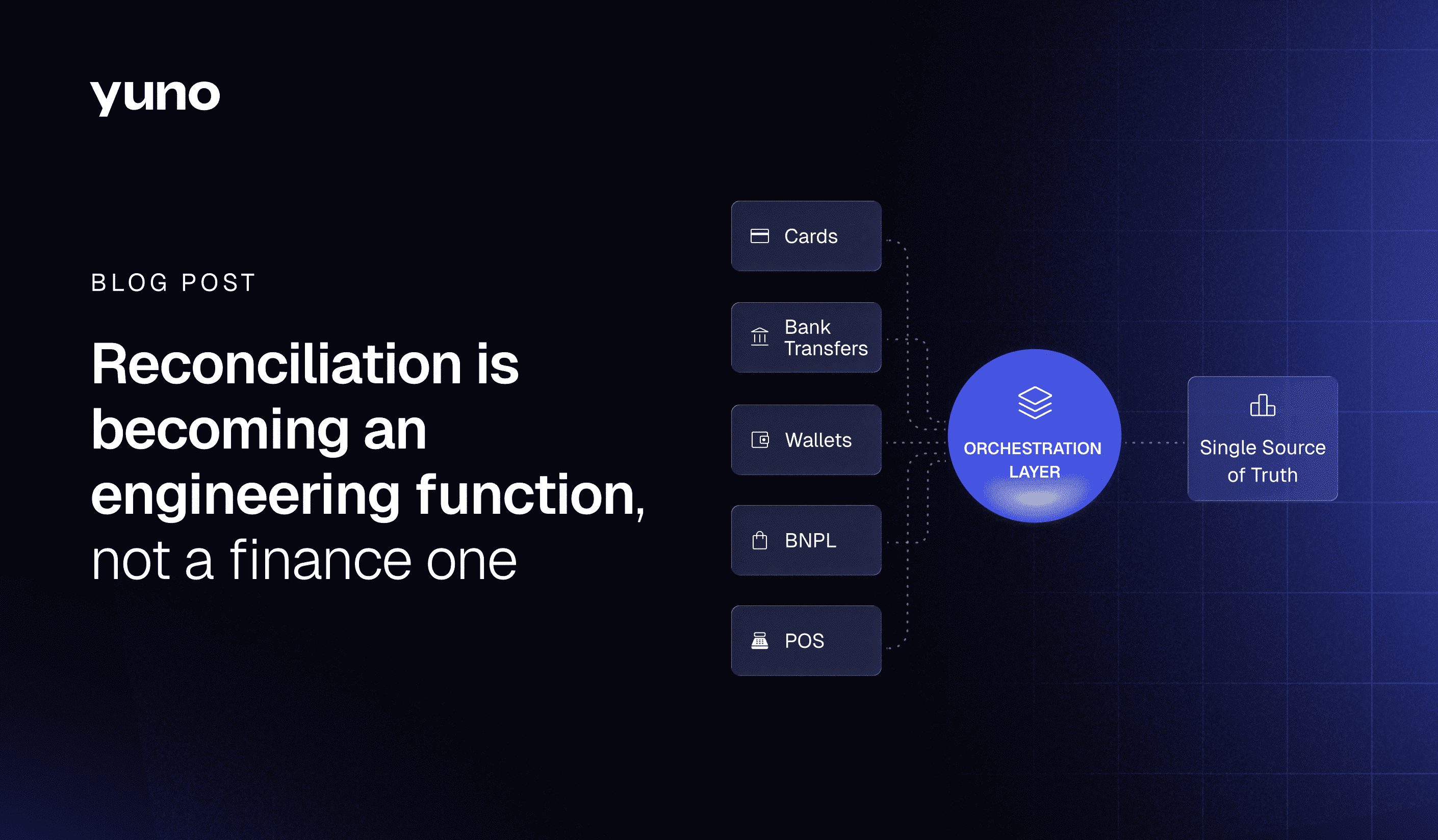
Payment reconciliation is becoming an engineering function. Payment method diversity, not volume, is what forces the migration to event-driven infrastructure.
AI payment analytics converts raw transaction data into real-time routing decisions, anomaly alerts, and approval rate improvements, without requiring analyst hours or manual dashboard review. Based on our infrastructure across enterprise merchants globally, the gap between detecting a payment issue and acting on it is where most revenue is silently lost. This post breaks down how AI closes that gap, what the operational shift looks like in practice, and what payment leaders should do first.
Most dunning subscription payments strategies fail because they treat every decline the same way. This guide breaks down how to build decline-code-aware retry logic, the right communication sequence, and how infrastructure choices determine how much revenue you actually recover.
See how AI agents can transform your payment stack.